Lovely Latkes

IMG_7697

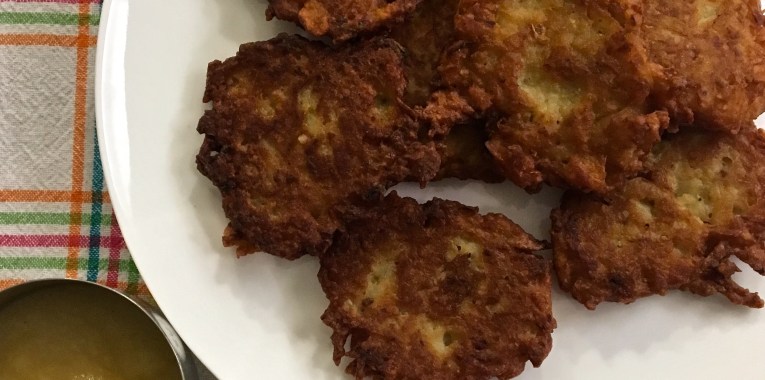
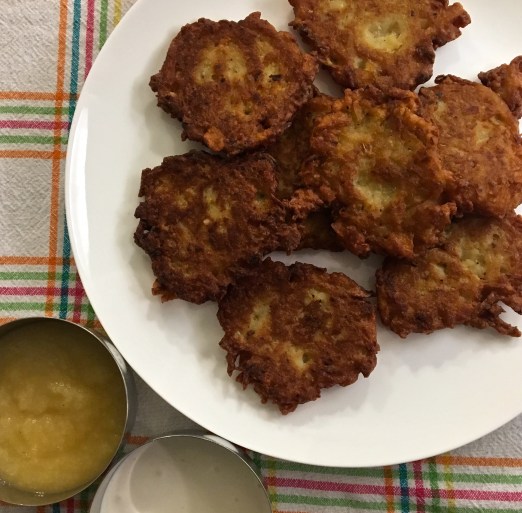
Latkes are a cornerstone of Hanukkah for Ashkenazi Jews. People usually have strong opinions about their latkes, and variations abound. The more traditional recipes include shredded russet potatoes and onions, some egg and a little flour to bind them together, and some salt and pepper for flavor. Form into a loose patty, fry, and, voila, your basic latke. This version gets nice and crispy, especially the craggy edges. Other recipes call for more flour and matzo meal, making a thicker, more patty-like version, like you may see in a Jewish deli. They’re more substantial, and generally have a smoother appearance, which also means they tend to lack the crispy irregular edges. I like it when they fall somewhere in between. And as far as I’m concerned, they should always be served with sour cream and applesauce.

I make a version I adapted from the recipe in The 2nd Ave Deli Cookbook. If you follow their recipe exactly, it results in something like a potato kugel dressed up as a latke (in fact, I believe the ingredients are the same for both recipes, they’re just cooked differently). I decrease the matzo meal by half, up the salt, ditch the baking powder (so they get crispier), use a different kind of oil, and decrease the amount of the oil used in the mixture. I also collect and incorporate the potato starch from the shredded potatoes. It’s a natural thickener that I think improves the finished product.

I hope you enjoy them!

Potato Latkes

(liberally adapted from The 2nd Avenue Deli Cookbook)

2½ pounds potatoes

2 large onions

3 eggs, beaten

½ cup vegetable oil, plus a lot more for frying

1 cup flour

2½ teaspoons salt

¼ teaspoon ground black pepper

1 cup matzo meal

Applesauce and sour cream

Makes about 30 latkes about 2 1/2 inches across—the number of latkes the recipe yields will vary based on how thick and wide you make them.

  1. Peel and grate the potatoes. Strain to eliminate the excess liquid. I place the grated potatoes in a strainer over a bowl and press out the liquid, letting it collect in the bowl. You may have to squeeze the grated potato as well to really get the liquid out. When you pour the accumulated liquid out of the bowl, a layer of white starch will remain. Keep it! Add the starch to your mix.
  2. Grate the onions (do not drain) and add to the potatoes.
  3. Add the eggs, 1/2 cup oil, flour, salt, and pepper. Mix well. Add the matzo meal and stir until the mixture is well blended.
  4. Heat oil in a skillet over medium heat. It should be nice and hot. Test by tossing in a shred of potato. It should start to crisp up quickly. Spoon batter into the pan and press down a bit to flatten, if needed. Fry until the pancakes are a deep golden brown, turn, then flip and fry the other side. Drain on paper towel. (If you’re not going to eat them all right away, they freeze well.)
  5. Serve with applesauce and sour cream.

IMG_7685

CSA, Week 8

IMG_1479

Week 8: Purple and white potatoes, orange cherry tomatoes, husk cherries, pistou basil, green and purple bell pepper, garlic, squash, and string beans.

This week is pretty representative of some of the best things about this CSA…. The joy of finding something new; in this case, husk cherries. I love these little guys. I’ve basically been a husk cherry evangelist, singing their praises to may over the last two weeks and getting a couple of converts under my belt. Three colors of string beans. A dark purple bell pepper. Squash with yellow and pale green stripes. Pistou basil. Cherry tomatoes genuinely bursting with sweetness. Garlic bulbs caked in dirt, evidence of how recently they were unearthed. It’s these subtle variations and these signs of small-scale farming with a focus on diverse varietals that make this CSA so rewarding.

Pork Tenderloin Wrapped in Bacon


My husband and I are new to pork tenderloin. I recently saw an episode of Ina Garten’s new show where she made one and I was intrigued. (http://www.foodnetwork.com/recipes/ina-garten/cider-roasted-pork-tenderloins-3742577). Not long after, I noticed the cut on sale and figured, why not? I tried Ina’s recipe. We liked it, but mostly we couldn’t believe how great pork tenderloin is. What a couple of fools to have not realized that before. I tried Ina’s recipe a second time with a few tweaks and (sorry, Ina) liked it better. The recipe has too much stuff going on: hard apple cider, maple syrup, rosemary, fennel seed, ginger, cinnamon, coriander, pepper…. For take two, I dropped the ginger and cinnamon, and went with a pear cider (we were out of apple). Here’s a shot of it sliced, and a shot of lunch the next day, with a more thinly sliced tenderloin, salad, and quinoa…

Pork Tenderloin SlicedPork Tenderloin

It had less dynamism, and I mean that in a good way. The original kind of jumped around the palate with so many things going on. But I digress. This is about the “weeknight porchetta” recipe from Bon Appétit (Jan. 2015) on epicurious.com.

Weeknight Porchetta

http://www.epicurious.com/recipes/food/views/weeknight-porchetta-51260410

Weeknight Porchetta 1
Ready for the Oven
Weeknight Porchetta 2
(A Little Over)Done
Weeknight Porchetta Leftovers
Leftovers

Notes: I used a frying pan to roast the tenderloins because I intended to put it on the stovetop at the end of cooking to crisp the bacon. But there was way too much liquid in the pan for that. I opted for the broiler, but the result was uneven. Also, the tenderloin got overcooked. I checked the internal temp at 25 minutes (cooking time is given as 40-45). I let it go another 8, which was too much, and then broiled a bit (for aforementioned crisping). Tenderloin is pretty forgiving, so it still tasted good, but I certainly should have taken it out a lot earlier. Though not in the recipe, I added as many tiny little potatoes to the pan as I could fit in. Great choice. They were amazing—tiny potatoes roasted in bacon fat and lightly flavored with rosemary, garlic, and fennel seed. The next day, I had some cold slices with a simple arugula salad. It was a little dry, but not terrible, and the cold bacon wrap was less unappealing than I had feared it would be. The leftovers from Ina’s recipe were fantastic—again, just had it sliced cold alongside a salad.

Would I try this recipe again? Maybe, in a bigger pan with a lot more potatoes, and if I could get the bacon to crisp up evenly and not overcook the thing.