Three Stones: Exceptional Mayan Food in Brattleboro, Vermont

IMG_1995

Three Stones restaurant occupies a tiny, unassuming space, barely noticeable as you wend your way into downtown Brattleboro, Vermont from I-91. But do not just drive by. Turn around, go in, and eat. Their food is exceptional. Better yet, make a reservation–there aren’t a lot of tables and it’s only open Wednesday through Saturday, 5 to 9 pm.

It’s a small space, with a bar up front, a small dining room, and a cozy, warm, festive outdoor space (which is likely not much in use during these winter months). The menu is small, offering only a handful of options, mostly traditional Mayan food. Everything we had was phenomenal. It felt like food prepared by a loving grandmother. So authentic, so homey, so delicious. I haven’t been that satisfied by a restaurant meal in a very long time.

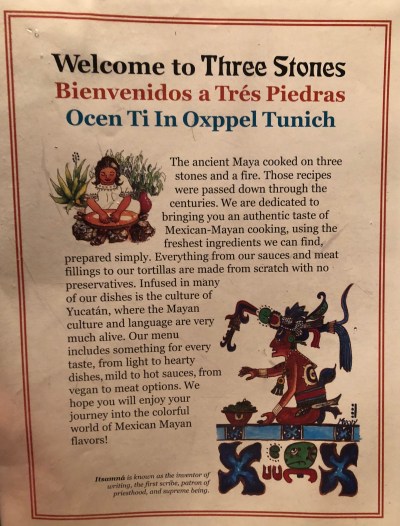
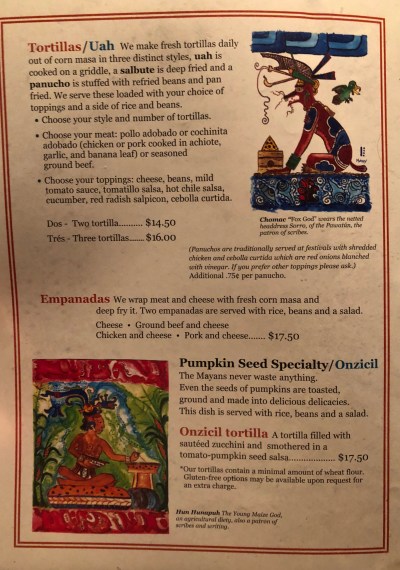
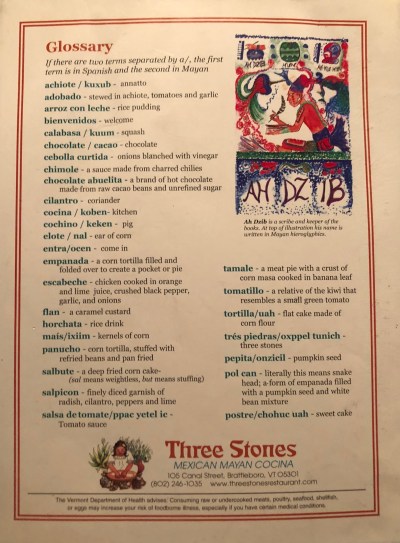
The menu itself touches on the food culture of the Mayan people. Educational, and also very pretty! Here it is:

IMG_1990

IMG_1992

IMG_1993

IMG_1994(1)

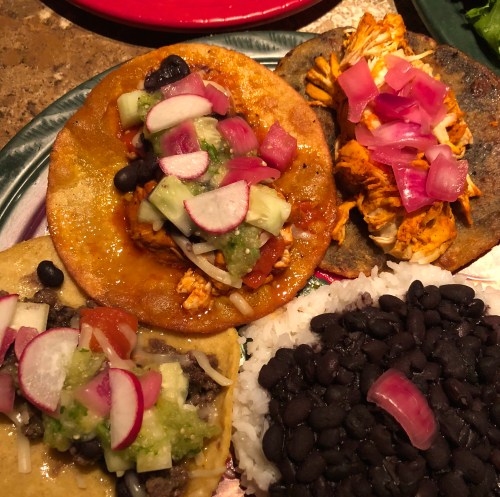
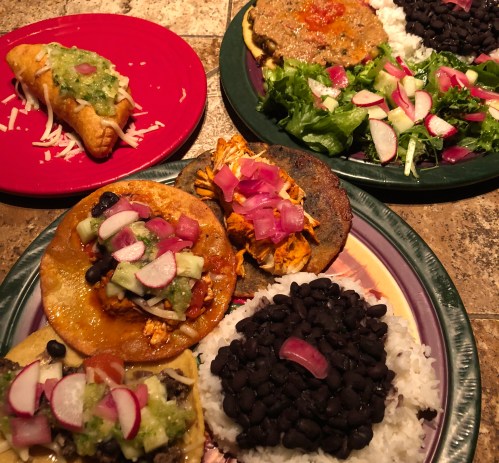
We tried the tortillas and the onzicil (pumpkin seed specialty) tortilla. We got three tortillas, choosing an uah (griddled tortilla) with ground beef, a salbute (deep-fried) with cochinita adobado, and a panucho (stuffed with refried beans and pan-fried) with pollo adobado. As the menu describes it, the adobados are “chicken or pork cooked in achiote, garlic and banana leaf.” We got all the toppings on each: cheese, beans, mild tomato salsa, tomatillo salsa, hot chile salsa, cucumber, red radish salpicon, and cebolla curtida (pickled red onions). The tortillas differed from one another in texture, taste, and thickness, but each one was earthy, comforting, filling, and satisfying. I was rather fond of the panucho, with it’s thin filling of refried beans adding savory depth to the flavor as well as a certain heftiness to the tortilla. I also enjoyed the salbute, the deep-fried tortilla, because, well, deep-fried things are generally delicious.

IMG_2007
From bottom left to top right, an uah (griddled tortilla) with ground beef, a salbute (deep-fried) with cochinita adobado, and a panucho (stuffed with refried beans and pan-fried) with pollo adobado; each includes all the toppings.

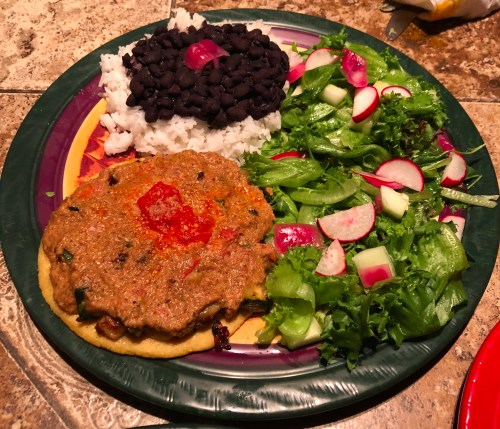
I was most excited to try the onzicil tortilla, which is a thick tortilla topped with sauteed zucchini and onions and then covered with a very thick sauce made from ground pumpkin seeds and tomato. It was delicious. The sauce, almost more like a paste, was nutty, earthy, and rich. The dish was rounded out with the fresh notes of the zucchini and the sweet notes of the sauteed onion. We also tried a chicken and cheese empanada, which was nice, if a bit prosaic.

img_20111.jpg

Chicken and cheese empanada

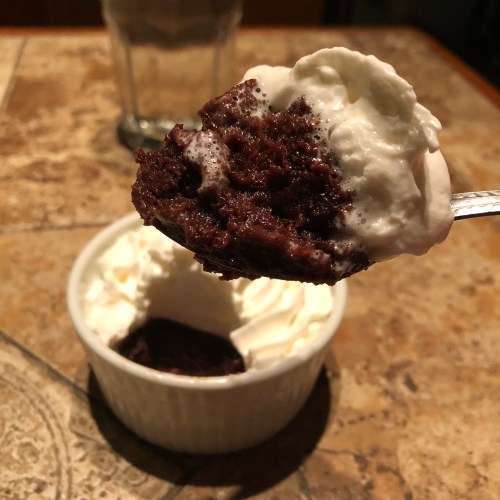
Though I rarely get dessert, we decided to get one of each of their two desserts. First was a boca negra, somewhere between a flourless chocolate cake and a chocolate pot de creme with a touch of chili pepper. It was warm, topped with whipped cream, and absolutely delicious, not too sweet and yet not overly bitter, with a lingering heat from the chili. We also got a dulce de leche, which was tasty and sweet. If you are going with just one dessert, I say make it the boca negra.

Boca negra

Dulce de leche

I so thoroughly enjoyed the food, and found it so comforting and (excuse the corniness) so filled with love. I recommend this place very highly. “Coox hanal,” which is Yucatec Mayan for “let’s eat.”

Maine: Some Notes on What We Ate, Part 3, Camden

IMG_2766

Our trip to Maine included a few days in Camden, a picturesque town on Penobscot Bay. Long a summer playground for wealthy vacationers, the town’s notable cultural attractions include the Camden Opera House and the Camden International Film Festival. You can stroll along the couple of blocks of Main Street, tucking in and out of shops that range from run-of-the-mill souvenirs to high-end home furnishings and clothing. There are many options for sailing out onto the bay. If you want to do some hiking, there’s Mt. Battie and the higher Mt. Megunticook, both of which offer gorgeous views. And then there’s the food…

Long Grain

20 Washington Street

IMG_2595

Long Grain is a much lauded, practically cult-status Thai restaurant in this tony coastal town. They’ve had coverage by The New York Times, Boston Globe, Bon Appetit, Saveur … you get the gist. The Times article, from 2012, starts by referencing Lotus of Siam in Las Vegas, a truly cult-status Thai restaurant, and that Gourmet article by the late, great Jonathan Gold in which he called Lotus of Siam the very best Thai restaurant in America. Needless to say, Long Grain was on the top of my list of places to eat in Maine, and my expectations were very high.

We ordered too much, as we usually do when we finally get somewhere we’ve been wanting to go. For appetizers: pan fried garlic chive rice cakes with sautéed bean sprouts and northeastern style Thai beef (nua nam tok). For mains: wide rice noodles with sweet soy sauce stir-fried with greens and pork belly (pad seaw) and beef panang curry with roasted red peppers, bamboo shoots, and Thai basil. For dessert: coconut flan.

Nua nam tok matches spicy beef with refreshing herbs for a dish of diverse yet balanced flavors. The rice cakes were tasty, if a bit glutinous…and a bit oily.

IMG_2581

IMG_2578

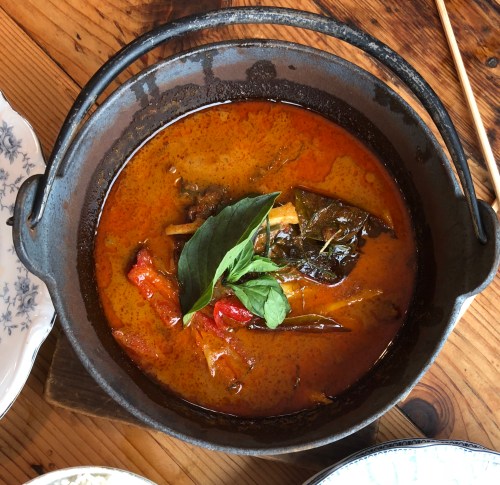
The specialty curry was beef panang, a thick red curry with braised beef, topped with kefir lime leaves and Thai basil. The sauce is a profound marriage of flavors, including, among other things, chiles, lemongrass, and galangal, and is thicker and less sweet than iterations you might get elsewhere. It’s a lovely dish: rich, spicy, and nuanced.

IMG_2584

The pad seaw with pork belly uses their signature house-made wide rice noodles. I couldn’t believe how thick the noodles were—unlike any others I’ve ever had. I actually found them too thick (though, admittedly, I lack the necessary experience to know if this is how they should be). I was also struck by the fact that the greens (kale) were practically whole they were so large. And the pork belly was sliced very thin, which detracted from the best qualities of the cut—tender meat, soft fat that crisps up when rendered. All in all, the taste was very pleasant, with notes of sweetness and acid as well as heat from sliced red chiles, but the texture of the noodles, the tougher-than-expected pork belly, and the size and relative unwieldiness of the greens detracted from the dish.

IMG_2585

IMG_2587

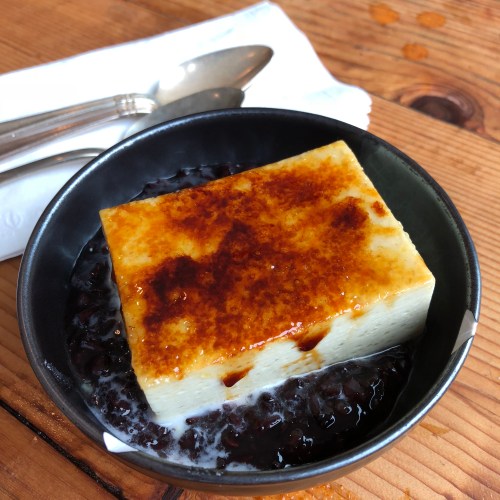
We finished the meal with the one dessert they make—coconut flan.

IMG_2590

The restaurant itself is a wide-open space, airy and modern, just off Camden’s main drag. My husband and I marveled at how much empty space there was! There’s probably room in there to double the seating capacity. And given the number of people who want to eat here, I can hardly believe they don’t. And did you notice the dishes? An eclectic mix of dainty, floral, modern, and Asian. And there’s a small market to the side of the dining room where you can pick up some Thai/southeast Asian ingredients.

If I sound down on Long Grain, let me be clear that it is the best Thai food I have had on the east coast. I think they’re doing great things. They don’t seem to be changing their recipes for an audience they think will not be prepared for Thai food; rather, they are presenting the food in its full-flavored glory and trusting that the good people of (or, more likely, passing through) Camden will love it. The resounding verdict is that they do.


Boynton-McKay

30 Main Street

IMG_2708

Boynton-McKay is right in the middle of the short stretch of Camden’s touristy downtown. Opened in 1893 as a pharmacist shop, the space was transformed in 1999 into a restaurant serving breakfast and lunch. Boynton-McKay has impossibly high ceilings, loads and loads and loads of vintage charm, and a kitchen that offers lots of comfort classics. I loved this place the moment I walked in. You order at the counter in the back—the menu on a board above, some bakery items laid out before you, and a bustling prep area in full view—then grab a seat and wait. They make slow-roasted beef and pork that they use in things like tacos, sandwiches, Asian-flavored lettuce wraps, and burritos. They also have classic breakfast options, like eggs, hash, and French toast, and healthier plates, like steel-cut oatmeal and quinoa salad. Something for everyone. Oh, and they make bialys. That makes me happy. Go here.

We ordered a slow-roasted beef burrito, French toast, and a simple bacon and egg sandwich on an English muffin.

IMG_2666

IMG_2671

IMG_2667

IMG_2669


Drouthy Bear

50 Elm Street

Just south of Camden’s main drag sits the Scottish pub Drouthy Bear, which is as cozy as can be. It’s only been open since 2015, but the combination of classic pub ambience and a charming antique home make it feel like it’s been there for much, much longer. The menu offers Scottish/English classics (Scotch egg, haggis, pasties, bangers and mash) and American standards (burgers, nachos, Caesar salad). The standout for us was the chicken tikka pie—mild yet flavorful chicken tikka masala beneath a blanket of flaky puff pastry. And since it’s a Scottish pub, there were lots of great beers on tap and a long menu of whisky. This is the kind of place you want to be when a cold wind blows in off Penobscot Bay, warming up, tucking into a shepard’s pie, and sipping something delicious.


Zoot Coffee

31 Elm Street

IMG_2831

Zoot Coffee is a very nice coffee shop just down from the center of town (where Main Street turns to Elm). I sure enjoyed their iced espresso, and the baristas were absolute dolls to my daughter. Looking for coffee in Camden? This place does not disappoint.


Review: Hot Mess Kitchen

Hot Mess Kitchen

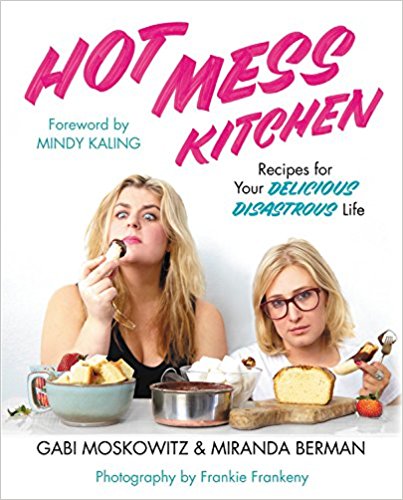
Hot Mess Kitchen: Recipes for Your Delicious Disastrous Life by Gabi Moskowitz and Miranda Berman

This book made me laugh. Many times, in fact. That’s not something an ordinary cookbook does, and this is not an ordinary cookbook. Hot Mess Kitchen is a genre-crossing book: part comedy, part memoir, and part self help. But importantly, it’s also an actual useful cookbook with usually amusingly named recipes (Bounced Check Burrito, I’m a Fraud French Toast, I Created a Relationship in My Mind Cupcakes, Bad Sex Baked Potatoes, and on and on). It’s a blast to read, and a nice gift idea for the twenty-something (or older) hot mess in your life.

Berman and Moskowitz have a mission: Get millennials to eat less take out and cook more, and they approach their mission with a hearty dose of humor. (Moskowitz is the editor-in-chief of the site Brokeass Gourmet and co-producer of the TV show Young and Hungry; Berman worked on the show The Mindy Project and for some time was the assistant to Mindy Kaling.) They also open up about their own struggles and, by example, encourage their readers to laugh at themselves a little bit while also giving them the confidence to make some changes. That’s no small feat.

While the recipes are humorously titled, they are real recipes to cook real food, and to prepare plenty of beverages as well–Chapter 6 is called “Let’s Get Drunk,” after all. Lots of carb-heavy recipes fill the “Broke AF” chapter. And there are lots of junk food-type recipes and ones that approximate take out. And since they wrote the book for the young and generally kitchen-challenged, they include short cuts like canned lentils (these actually exist?) in their recipes. But there are some more “elevated” options, like the chicken legs with kale and sweet potatoes, also know as “Cheap Chicken Legs (and a Free Trip to Europe).” They also offer good advice, like use a cast-iron skillet, and they walk you through stocking a pantry.

While the writing is genuinely funny and taps into the millennial zeitgeist, it’s also really honest and encouraging. Where was this book when I was twenty-something? The authors are honest about the big things, like not really knowing how to get started with a life on your own. See Berman’s essay about setting up a kitchen. She opens up about her fear of settling into a less-than-perfect life in a less-than-perfect LA apartment, and offers some good advice on dealing with that. And while accepting your first apartment as a home and buying dishes for the first time aren’t relevant to everyone, the honesty is welcome. And frankly, who can’t benefit from the advice that you can make something your own when its not what you had pictured, even if she already has enough flatware?

While the book is geared toward millennials, especially women, the humor, the advice, and, importantly, the recipes make it more widely relevant…and enjoyable.

The Cuban Sandwich: A Tampa Tradition

Sure, you know what a Cuban sandwich is. Ham, roast pork, Swiss cheese, pickles, and mustard on Cuban bread, usually pressed to crisp the bread, warm it through, and start to melt the cheese. But did you know that the Cuban sandwich was invented in Tampa, FL, and in the city, Genoa salami is also an integral ingredient? In 2012, the “Historic Tampa Cuban Sandwich” was declared the “signature sandwich” of the city by a resolution of the Tampa City Council. There’s a strong rivalry with Miami about which city is really the home of the Cuban sandwich. But history is on Tampa’s side, with the first evidence of the sandwich dating back to before 1900, well before they were on the scene in Miami.

According to local lore, the sandwich developed over time by adopting ingredients from the various immigrant communities that settled in Tampa. Cubans brought the ham and roast pork; Italians, the salami; and Jews and Germans, the Swiss cheese, mustard, and pickles. Of course, there was no concerted effort to create a sandwich to reflect all of these groups. But the story is emblematic of the way foods sometimes develop, taking a little from this group, a little from that, resulting in something new…and the story is certainly emblematic of American food.

Back to that public resolution: it is very specific about how a Historic Tampa Cuban Sandwich is made. It includes an eight-point list that lays out precisely how to make one—but remains oddly silent on the question of whether it should be hot or cold. A peek at the minutes of the City Council meeting reveals that they thought weighing in on this point would be micromanaging–hilarious! The level of specificity in the resolution is so delightful, I’ll share it in its entirety:

Be it resolved by the City Council of the City of Tampa, Florida:

Section 1. That the City Council of the City of Tampa hereby defines, designates and authenticates the “Historic Tampa Cuban Sandwich” as a sandwich which was prepared utilizing only the following ingredients and process:

1) Use Cuban bread which is an all-natural, white wheat flour loaf and is made by scoring the loaf with palmetto palm fronds, and which bread has been stored in a paper bag;

2) Cut loaf of Cuban bread into 8-10” pieces and cut bread lengthwise, with scored portion on top;

3) On bottom piece of bread place a slice of ham;

4) On top of ham, place a slice of Cuban style roast pork made by marinating the pork in garlic and mojo sauce;

5) On top of pork, place a slice of natural dried, cured Genoa salami;

6) On top of salami, place a slice of dry Swiss cheese;

7) On top of cheese, add 3 sliced dill sandwich pickles;

8) On top piece of Cuban bread (scored portion), spread yellow mustard and place on top of sandwich.

Now that’s taking the details very seriously.

After some research, we chose five places to try the sandwiches. We were able to get to just three of them: Columbia Restaurant, West Tampa Sandwich Shop, and Brocato’s Sandwiches. Due to two (!!) rental cars with problems (two separate useless cars!!), we did not get to try La Segunda Central Bakery or Michelle Faedo’s On the Go food truck. Sadly, we were most looking forward to those two. If we make it back to Tampa, we’ll make those two our first stops.
Columbia Exterior

Columbia Restaurant

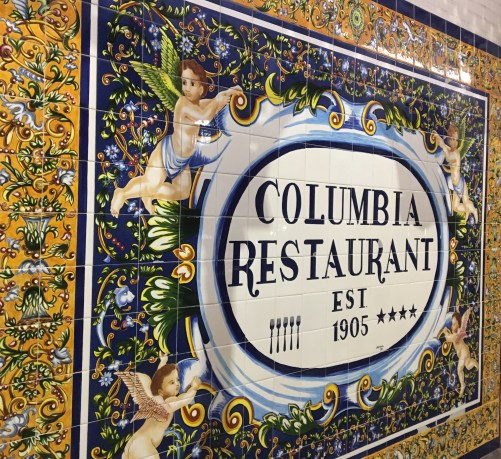
Columbia Restaurant is a sprawling building with multiple dining rooms and a gift shop. It’s been an anchor in the Ybor City neighborhood since 1905, making it Florida’s oldest restaurant (a title for which they have secured a service mark: Florida’s oldest restaurantSM). The original café, founded by Cuban immigrant Casimiro Hernandez, Sr., was known for Cuban coffee and Cuban sandwiches. It’s now owned by the fifth generation of the same family. The family has opened five more locations by the same name, stretching from Tampa to as far away as St. Augustine, as well as a seventh place called Ulele. Several tables around us were celebrating birthdays, and there were a number of large parties, and that was on a Wednesday. It’s that kind of a festive spot, if touristy.

Columbia Restaurant gives a little history of the Cuban sandwich on their menu. Created in the 1890s as the mixto, the sandwiches were developed for the workmen at the local Ybor City cigar factories. The restaurant uses the same recipe that they introduced in 1915. The menu includes that lore about the contributions of the various Tampa ethnic groups to create a sandwich that reflected the community: “The city of Tampa was like the sandwich, a mixture of cultures and food.”
Columbia Cuban

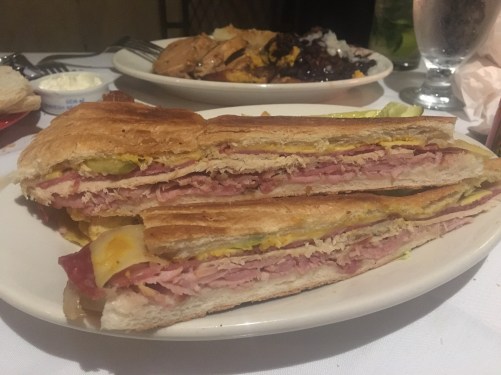
The Cuban bread at Columbia is from La Segunda Central Bakery. It’s as light as air inside with a faint sweetness, perfectly crisp and crumbly outside—just lovely. And that’s what they use for their Cuban sandwich. The bread is brushed with butter and pressed, so the airy quality is diminished, but the result is crispy, flaky, and toasty. The ham contributed a subtle sweetness, the roast pork gave a shot of unctuous, garlicky goodness, and the salami—a necessity in a Tampa Cuban—adds a gentle note of heat and spice. The Swiss had good bite, and the mustard and pickles didn’t overpower, but rather offered a foil to the richness of the trio of pork. The sandwich was in a way reminiscent of a ham and cheese croissant, flaky and buttery. It was well balanced, with all the ingredients standing out, but none hogging the spotlight. It comes with an ample side of plantain chips and a somewhat superfluous pickle. This was the best Cuban sandwich I had in Tampa.

West Tampa Sandwich Shop

West Tampa Sandwich Shop

A humble spot with an exterior that looks bleached by the hot Florida sun, West Tampa Sandwich Shop is another local institution. So much so, President Obama stopped by. He ordered a honey Cuban—honey is pressed into the bread to provide a sweet note—with lettuce and tomato, which is now the Obama sandwich on the menu. We got a classic Cuban and an Obama.

West Tampa Cuban

West Tampa Sandwich Shop is a no-frills place, and their Cuban was a no-frills sandwich. I had a few issues with it, like too much mustard, a skimpy slice of salami, and barely any roast pork at all. And the ham was pretty basic. But it was a good and satisfying sandwich nonetheless, and at $3.60 for the regular size, it’s easy to like. Note that they include mayo as a default, but the waitress did ask specifically whether we wanted each topping offered—mustard, pickles, lettuce, tomato, and mayo. As for the Obama, the honey pressed into the top of the bread provides a foil to the saltiness of the meats and the pickle, and the sharpness of the Swiss and mustard. The lettuce, tomato, and mayo add moisture to a sandwich that can tend to the dry.

Brocatos Exterior

Brocato’s Sandwich Shop

Brocato’s is clearly a Tampa tradition. The place has been around since 1948. While it wasn’t insanely busy when we were there, they are set up for massive lines. The décor belies the place of Brocato’s in the food history of Tampa—awards, mail order options, famous guests, etc.
Brocatos Cuban

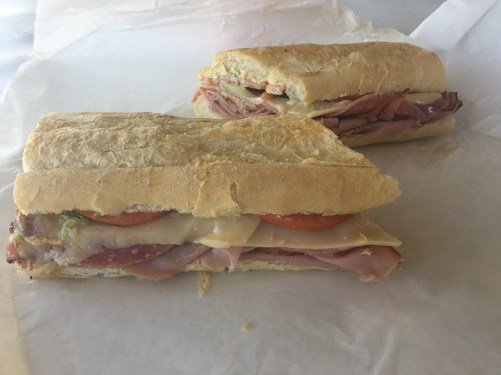
So, I ordered a Cuban sandwich here…in Tampa, as in “Historic Tampa Cuban Sandwich,” as in expecting the steps outlined in that city resolution…and what I got was a cold Italian sub with lettuce, tomato, and mayo, in addition to the requisite ingredients. It was on Italian bread—not pressed, not warm, not toasty. Not at all what I was expecting, or what I was on a mission to eat. The place is not cheap, and it takes a while to get your food. Sandwiches come with a small bag of chips (grab your own in the large garbage cans by the pick up window) and a soda.

Brocatos Devil Crab

To be fair, Brocato’s seems to be known for their devil crabs, another Tampa tradition. They have plenty of signage about how you can get them mail ordered. Devil crabs are essentially crab croquettes. The ones at Brocato’s are huge, and they’re known for that (note that they also serve minis). The filling included ample lump crab, but also a generous dose of green bell peppers and I believe tomato and onion. The crab filling was tasty, if a bit too wet and a bit too loaded up with peppers, but I thought the size ultimately worked against the dish, throwing off the balance between the coating and the moist filling.

Zuppardi’s Apizza: A West Haven, CT Landmark

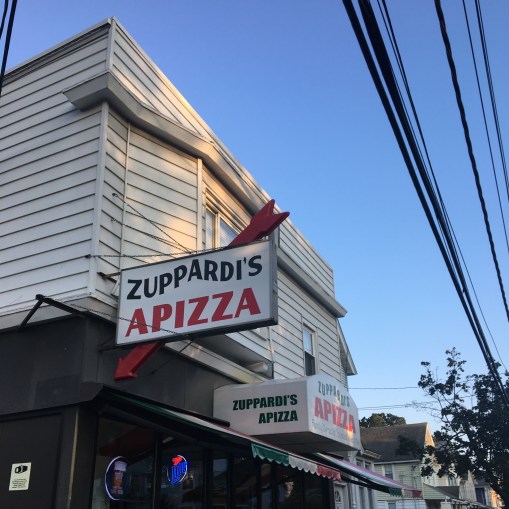
exterior

Just a short ride from New Haven pizza legends Pepe’s, Sally’s, and Modern, West Haven, CT has its own iconic spot: Zuppardi’s Apizza. For about eight decades, they’ve been serving up New Haven-style pizzas in an unassuming space in a residential neighborhood by the beach.

Master bread-baker Dominic Zuppardi originally opened a place called Salerno’s Bakery in New Haven in 1932, moving it to Union Avenue in West Haven in ’34. By the 1940s, Dominic’s son Anthony took over and started making pizzas. He changed the name to Zuppardi’s Apizza in ’47, and the rest is West Haven history. Anthony’s kids and grandkids run the place today, still at the same Union Avenue location.

The first Zuppardi pizzas were plain pies, just tomato sauce and pecorino—like the Original Tomato Pie over at Frank Pepe’s on Wooster St. with its crushed tomatoes, olive oil, oregano, and grated cheese. Zuppardi soon started to add his homemade Italian fennel sausage to the pizzas. It was a real success then, and remains so today.

slice with meat and veggies

Unlike some of its New Haven counterparts, Zuppardi’s doesn’t use a coal-fired oven, but rather a gas one. The dough is a little thicker than at the other places, and chewier, too, but it still delivers a crisped crust and the characteristic slight char of New Haven pizza. In fact, the dough has a lot of the characteristics of a great artisan Italian bread. And the toppings are all high quality.

two pies

Today’s menu remains true to its history. The Traditional Plain Pie is just that—tomato sauce and pecorino, with garlic upon request. (Note that in New Haven, and in West Haven, you specifically ask for mozzarella when you want it.) The Special Pizza is another Anthony original: red sauce, mozzarella, mushroom, and that homemade fennel sausage.

Zuppardi's clam apizza

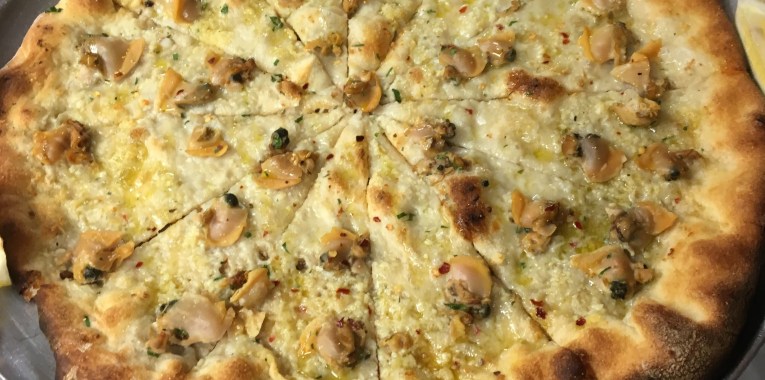
They also do a clam pie, a New Haven classic. As you can see above, it’s a thing of beauty. They use shucked-to-order littleneck clams along with garlic and spices, flecked with crushed red pepper, and served with lemon wedges. Many regard Zuppardi’s clam pizza as the best one in the area—myself included. Although it can be pricey (depends on the market price for the fresh clams), it’s delicious, and it’s best eaten right away. This is not the right choice if you’re looking for leftovers: the clams get hard and rubbery and the crust gets soggy. But straight out of the oven, it’s briny, garlicky bliss.

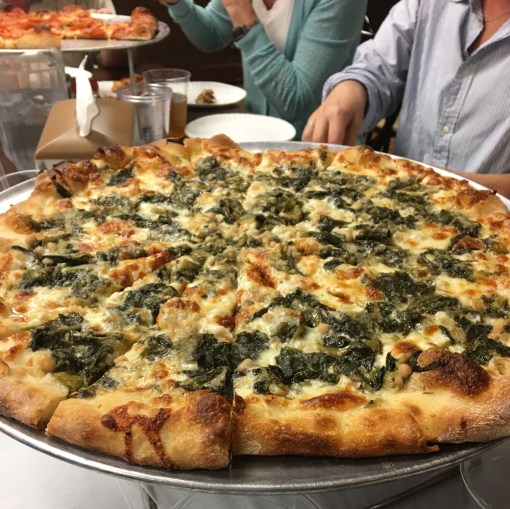
white bean and escarole

Another stand-out specialty is the beans and escarole pizza: a white pizza with cannellini beans, sautéed escarole, mozzarella, fresh garlic, and olive oil. Consider throwing in some of the fennel sausage, too. Zuppardi’s has all the usual toppings, too, of course, and a few questionable specialties, like Buffalo style chicken. They also have some other menu items, like salads and appetizers, which isn’t the case with all the big name places in New Haven. They serve beer and wine as well as the great Foxon Park sodas, another local treat. If you’ve never had their white birch, try it.

slices

If you’re exploring New Haven pizza, which you absolutely should do, take the short trip out to West Haven and sample the Zuppardi’s take on this regional specialty.

Zuppardi’s Apizza

179 Union Avenue, West Haven, CT

www.zuppardisapizza.com

Schwartz’s, Montreal

A Montreal icon, Schwartz’s has been serving up exceptional smoked meat (think pastrami, but with some subtle differences) in the same spot in the Mile End neighborhood since 1928. While the menu includes other deli classics, such as turkey, salami, and liver, people line up for the smoked meat, which is marinated for ten days and smoked fresh every day. Get a smoked meat on rye and a ½ sour and you’ll see why they have a passionate following after so many decades—sliced thin and piled high, the meat is tender and packed with flavor. You can get the meat normal or lean, with or without mustard. The fries are also tasty.

3895 Saint-Laurent Boulevard, Mile End

Open seven days

8:00 am to at least 12:30 am; hot meat (including the smoked meat) available after 10:30 am

Nouilles de Lan Zhou, Montreal


Perched above a small grocery store with which it shares an entrance, Nouilles de Lan Zhou is an unassuming Chinatown restaurant that churns out spectacular hand-pulled noodles. Before you step inside, watch from the sidewalk as the noodle makers roll, stretch, and pull the long ribbons of noodles, thick and thin.

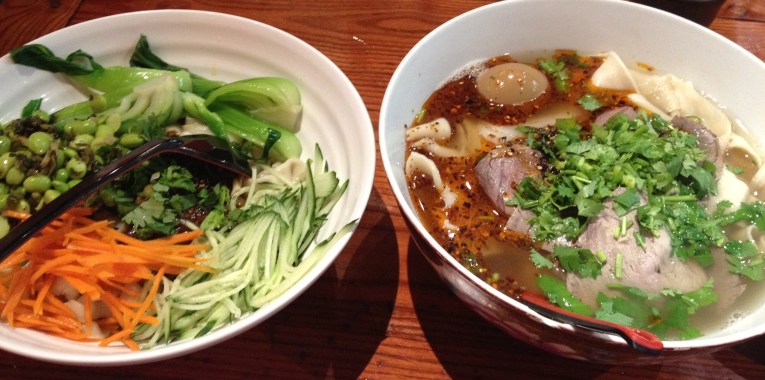
The house specialty is noodle soup in the Lan Zhou style: a mild broth with thin sliced beef, cilantro, green onion, and chili oil—the amount used corresponds to the level of spiciness you request. There’s also chili oil at the table, in case you want more heat. The soup comes in three sizes, and the large is enormous. You also choose the shape of the noodle—round or flat, each available in several sizes, from moxi, the thinnest round noodle, to da kuan, which is the widest flat noodle, upwards of an inch wide. Get the combo, which includes a side salad—choose from edamame, spicy cucumber salad, or pickled vegetables—as well as a delicious tea egg added into your soup.

Also spectacular is the noodles with pork sauce (zhajiang mian), a dry (broth-less) dish with flat noodles and pork in a heavenly fermented bean sauce along with edamame, cucumbers, carrots, bok choy, and cilantro, served with a side of clear broth. (I’ll admit it: I went back to Nouilles de Lan Zhou a second time to get another plate of this dish. It’s amazing.)


1006 Boulevard Saint-Laurent, Chinatown

11 to 9 (9:30 on Friday and Saturday)

Open 7 days

Agrikol, Montreal

One of the very hottest spots in Montreal right now, Haitian restaurant Agrikol is a festive space decorated with art from the island, exuding a warm, welcoming vibe. Opened in early 2016, it is the work of two very hip couples: Régine Chassagne and Win Butler, members of Montreal-based Arcade Fire; and Jen Agg, owner of Toronto’s Black Hoof and Rhum Corner, and Roland Jean, a Haitian-born Toronto-based artist.

The menu revels in Haitian classics, like griot and oxtail stew, as well as conch, accras (savory and starchy beignets), and whole fried fish. The griot is a real standout—pork packed with flavor and a little heat, slow cooked then fried for a crispy exterior—atop pickled onions and served alongside fried plantains and a vinegary cabbage slaw. Add a side of rice and peas and you’ve got a deeply satisfying meal.

Agg has a strong cocktail background, so it’s no surprise that Agrikol has an interesting drink menu, dominated by rum. Haitian Rhum Barbancourt has a strong presence, and is available by the glass, half bottle, and full bottle. The Ti punch pairs Barbancourt with fresh-pressed sugar cane juice and lime. The Dark and Stormy uses house-made ginger beer brewed with black peppercorns, for a strong and spicy companion to the rum.


1844 Rue Amherst, The Village, Montreal

Open everyday 6 pm to midnight

No reservations

http://agrikol.ca/