CSA, Week 1

IMG_E0033

We finally did it—we bought a CSA share. Kinda hard to believe it’s our first time. Honestly, I’m not sure why we’ve never done it. But now we have, and I’m pretty excited.

Our share is at an organic farm in town. Pickup is at the farm, which is as quaint and charming as you could imagine. An old farmhouse and enormous barn on acres and acres of lovely fields with open views of distant hills. The farm store carries the shelves of CSA items that you grab yourself (or containers for pick-your-own options—this week, you could pick your own strawberries). There are also additional items for sale from the farm, as well as items from other local producers. It’s the kind of place you’d love to have your kid remember when she grows up. I hope my daughter remembers it. I’m glad she can have this kind of experience buying food. I’m glad that I can have it. Here are a few pics:


As the picture at the top of the post shows, our first share included spring garlic, choice of cilantro or chives (we went with the latter; we have cilantro all the time, and I couldn’t remember the last time we had chives in the house), pick-your-own strawberries, radishes, arugula, pea tendrils, and kweik buttercrunch lettuce. My husband, my daughter, and I all went to the pickup together, but, unfortunately,  I had to run back to work and couldn’t join them for the strawberry picking.

I’ll post images of some of the things I make this week on Instagram.

Spinach Pakoras

IMG_8028

About two months after I had my daughter, back in 2014, my in-laws came to visit to meet their first grandchild. As I have mentioned, my mother-in-law is an amazing cook. Soon after she arrived, she started to work tirelessly, cooking for us to stock our fridge and freezer with some of the tastes we loved, knowing that we sometimes struggled to take care of our own needs after caring for our baby girl. Despite repeatedly imploring her to stop cooking and enjoy her time with her granddaughter, she would not and could not. And for weeks after they left, we reaped the benefits of her drive to feed those she loves.

As most first-time moms can likely attest, feeding myself was a second thought at best. My mother-in-law’s spinach pakoras proved to be a godsend. She left me a gallon-size bag of them in the fridge and another bagful in the freezer, along with homemade tamarind sauce. I ate them pretty much every day, at any and all times of day. A pakora is a deep-fried vegetable and as such is supposed to have a crispy exterior, but I relished even a soggy plate of them straight from the microwave. While I sacrificed that texture in order to have them ready to eat them more quickly, their well-rounded spiciness made up for what was lost. They nourished me while I was learning how to take care of my daughter.

My mother-in-law almost always makes us spinach pakoras when we visit. While I love them freshly fried, I still adore taking home a bag of them, and heating them up in the microwave—whether for breakfast, lunch, dinner, or late-night snack. The spicy, soggy patties always remind me of those first spectacular months as a mom.


Philadelphia: Some Notes on What We Ate

Philadelphia is such a great food city. It’s the fifth most populous city in the U.S., which for some reason I find surprising even after hearing it…and confirming it…several times. Perhaps because it has sometimes been overshadowed by near-ish neighbors NYC and DC. Despite its relative proximity to these culinary juggernauts, the food scene in Philly just keeps getting hotter and hotter.

We recently took our second trip to Philly as a family. It was only for two nights, but we still got to try a lot of great places. Here’s a brief rundown of what we ate, along with a brief synopsis of some of the very lovely food we had last year.

CHeU Fishtown

1416 Frankford Ave, Philadelphia

When we got to CHeU Fishtown, our waiter summed up their menu as Asian-Jewish fusion. The CHeU website spells out their approach to food:

“What do we, two dudes from Philly, know about ‘authentic’ Asian cuisine? Nothing. Lucky for us, that’s not what CHeU Noodle Bar & Bing Bing Dim Sum are all about. We cook what we like to eat — it’s personal, no matter what we put in front of you. Our food is often informed by tradition, but it’s never defined by it. All that we require of you is a willing mind and a willing stomach. We might not be ‘authentic.’ But we do keep it real. – Ben & Shawn”

I love these types of “fusion” foods—foods that liberally and lovingly share different influences and cultures. To me, it’s a unique expression of American food. That said, such combinations don’t always work. Sometimes it can be hard to get your head around certain flavor combinations. I had some moments like that at CHeU Fishtown.

We got the brisket ramen with kim chi and a big old matzo ball. Asian-Jewish fusion. This one was a little hard to process taste-wise. I’m not sure if it totally worked for me, but I love the idea, and the components were good, especially the matzo ball.

IMG_8402

Duck in red curry with kasha and gribenes (usually crispy chicken skin, though likely duck skin in this case—I didn’t think to ask at the time). Again, great components of the dish, but not sure I fully understand the kasha and red curry combo.

IMG_8407

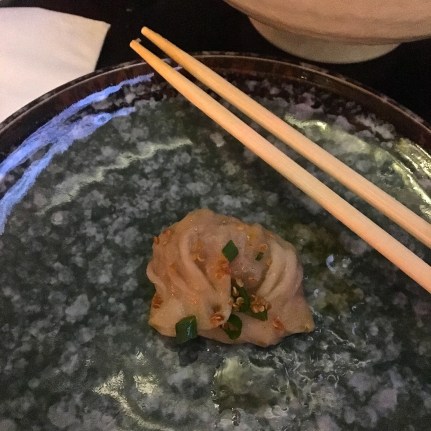
Beef and kim chi dumplings. These were pretty straightforward and good, but they were neither traditional nor particularly genre-bending.

IMG_8384

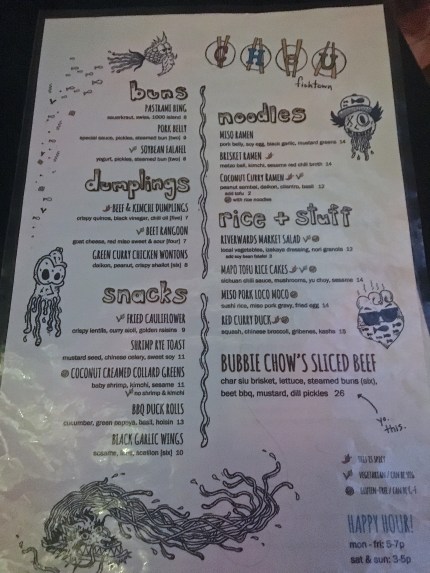
The menu. Not a great shot, but hopefully you can make out some of the dishes, and the way they playfully mix and match flavors and cultures. My thoughts above on the dishes we ate may seem like I was underwhelmed, but I did really like what this place was all about. And all three of their locations are wildly popular, so what do I know?

IMG_8373

Federal Donuts

1632 Sansom St.

Federal Donuts is one of Michael Solomonov’s many Philly eateries (he’s also behind Zahav, Abe Fisher, Dizengoff [see below], Goldie, and Rooster Soup Co). Oh, heavenly donuts! I do not have a sweet tooth, but these donuts—blissful…and gorgeous, don’t you think? Clockwise from top left: cinnamon brown sugar, chocolate caramel banana, strawberry lavender, and snow cap (coconut). Some come hot out of the oven—be sure to get at least one hot one.

IMG_8415

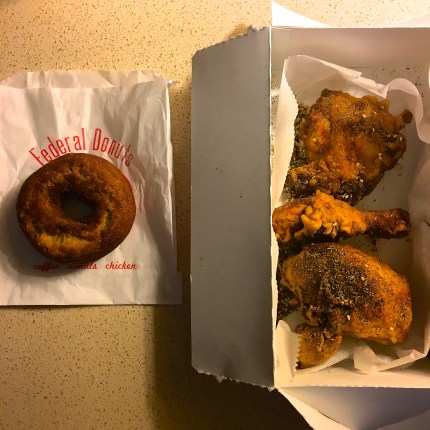
Federal Donuts also serves fried chicken with a choice of dry seasonings or glazes. Here with za’atar. The skin is almost preposterously crispy, and the meat is as tender and juicy as can be. A half order (breast, leg, and thigh) comes with one honey donut.

IMG_8426

Dizengoff

1625 Sansom Street

Another Solomonov restaurant, just across the street from Federal Donuts (in fact, Abe Fisher, Rooster Soup Co., and Goldie are also all on Sansom, just a stone’s throw from each other). This is a hummus place, with a location in Miami and a spot in Manhattan’s Chelsea Market. The hummus here is creamy and amazing, and the toppings really sing. We got fennel and almonds, as well as a side order of the meat of the day, which was chicken with apricots. Check out their social media for the daily offering. The pepper walnut hummus was really good too, though in smaller doses.

Far left: fennel almond hummus; middle, top to bottom: chicken with apricots, beets with a pickle, and pepper walnut hummus; and right, amazing pita.

IMG_8425

Stargazy

1838 E. Passyunk Ave

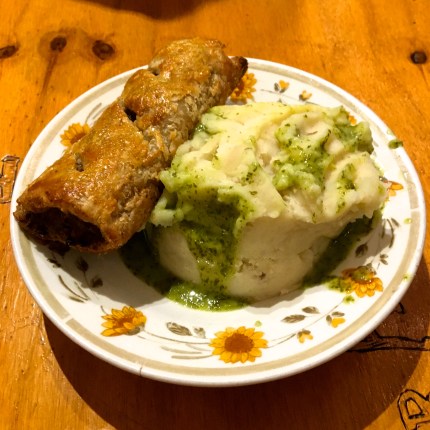
An East End-style “pie and mash shop” on Passyunk. Primarily a lunch place, we got there in the late afternoon and there were no more pies left (sad face), just a sausage roll. The mash comes with parsley liquor, a fresh and slightly tangy note in an otherwise very savory plate. What we had tasted really good, and we imagine the meat pies are amazing. Next time, we’ll go for lunch. They also serve jellied and stewed eels as well as sweet pies.

IMG_8477

Saté Kampar

1837 E. Passyunk Ave

This Malaysian place on East Passyunk is popular, hip, and, most importantly, delicious. Well known for their saté, they offer a handful of choices of meat marinated in one of two ways (essentially sweet or salty), then skewered on a stick and cooked over coconut shell charcoal, served with peanut sauce. The flavor is so unique, nothing like the garden-variety Thai restaurant saté we all know well.

We also had the rendang daging, or beef rendang. Of course we ordered it, since it’s basically one of the greatest dishes ever. This iteration was deeply satisfying, rich and packed with flavor, with subtle heat, spice, and sweetness, although chewier than ideal. We also got the achat, essentially pickled carrots and cucumbers with peanut sauce. While the dish was fine, there was way too much of it and I would only recommend it if a large party was going to share it, with each person just having a small portion. Unfortunately, they did not have the nasi lemak bungkus (coconut rice stuffed with crispy anchovies and more, wrapped up in a banana leaf) that night. I heard they’re amazing. Next time. Oh, and I’d also try the ayam kurma, a coconut-based chicken and potato curry.

Sate Kampar is BYOB, but they have a tea and coffee bar with a wide range of drinks—in fact, it takes up half the menu, with images of the many permutations of coffee, tea, condensed milk, evaporated milk, and sugar. The drinks are made in full view and many involve some showmanship.

IMG_8493

El Compadre

1149 S. 9th Street

El Compadre is simply lovely. A small space on a busy street in the Italian Market neighborhood. They are known for their barbacoa, a slow-cooked lamb dish. This place is a new iteration of the former South Philly Barbacoa, which won national attention for its succulent rendition of its namesake dish.

The current place is cheerful and cozy, with warmly colored walls, vibrant art work, and bright table cloths. It gets very, very crowded and the set up can make for close quarters, but it remains festive, and the staff is attentive and very warm. I believe the barbacoa is only available on the weekend. Definitely check before going.

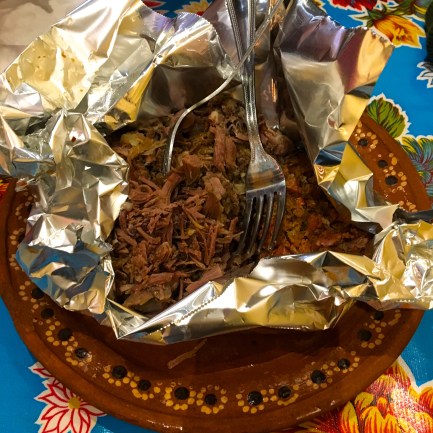
When you walk in, you’ll line up by the stand where the meat is chopped up for your order. You order by weight, half kilo (just over a pound), kilo, etc. We got a kilo of mostly lamb, some pork. We sat down with our meat and were brought lamb consommé with chickpeas, rice, and flecks of chile pepper. The order of meat also includes tortillas, onions, pickled vegetables, cilantro, and nopales, as well as a few salsas. The lamb is mild and meltingly tender, and the toppings let you dress up the meat as desired. You can also order tacos and tortas, but I wholeheartedly suggest getting the meat with the sides and making your own. This place is not to be missed.

IMG_8536

Our Last Trip, February 2017

Our last trip to Philly included meals at Zahav, the award-winning Israeli restaurant that put Michael Solomonov on the map, so to speak; John’s Roast Pork, a classic place for a classic Philly sandwich of roast pork, greens, and aged provolone, and a winner of a James Beard America’s Classics Award; and V Street, which serves vegan takes on international street foods, a sister restaurant of Vedge. All three are still going strong and definitely worth a stop. If you want to go to Zahav, you’ll need to make a reservation well beforehand…or line up before they open. They have seats at the bar as well as at a long bar that looks right into the kitchen. We got there about 20 minutes before opening on a Sunday and scored seats.

Southwest Excursion: Some Notes on What We Ate

DSC_0039

My husband and I, along with our three-year-old daughter, just returned from an almost-two-week trip through the Southwest. We wound our way through Arizona’s Navajo country, northern New Mexico, and a corner of Utah, seeking out petroglyphs and ancestral Puebloan (Anasazi) ruins, soaking in the exceptional landscape and boundless sky, eating fry bread and chiles. Our soundtrack much of the time was 660 AM, the voice of the Navajo Nation, punctuated by our daughter’s occasional chants of her desire to go home. Here are some notes on some of the more notable things we ate.

NOTE: What I won’t be writing about in much detail is the amazing things we saw on this trip that had no ties to food, like the really truly blow-your-mind phenomenal Chaco Culture National Historical Park; the varied other-worldly landscapes of Petrified Forest National Park; the artistic expression of human culture, history, and experience etched into rock in Petroglyph National Monument in the hills above Albuquerque, the sprawling metropolis set out before you; the stunning 13th-century architectural feats of Hovenweep; Acoma Pueblo with its rich artistic traditions and crushing history under the Spanish; the Abiquiu studio of Georgia O’Keefe and her museum in Santa Fe; and on and on. What an amazing area to explore. Every time I’m in the area, I can’t help but fantasize about living there, New Mexico especially. I highly recommend visiting.

Indian Gardens Cafe and Market, Sedona, AZ:

We didn’t intend to go to Sedona. As we arrived in Petrified Forest National Park, I realized I left my camera battery and charger in our hotel room in Gallup, NM, and driving back to Gallup was not an option. Many calls to many stores between there and Flagstaff, our next stop, showed that a Nikon dSLR battery was simply not available. Rollie’s Camera Shop in Sedona, however, had the battery and a charger. We really didn’t want to rely on just smartphone cameras for this trip, which was only on day 2 at this point, so we changed course and headed south.

Route 89A from Flagstaff to Sedona curves through the Coconino National Forest, revealing exceptional views, especially as you hit the series of extreme switchbacks and ultimately make your way down through Oak Creek Canyon, where the road meanders alongside the river, through apple orchards, past campgrounds and cabins, vacation homes and fishing holes.

We stopped at the Indian Gardens Cafe and Market, which is a few miles north of the town of Sedona. It’s a charming place, and as the name suggests, it’s also a market with treats like apples grown in the local orchards. The cafe has options ranging from light and healthy to decadent comfort food. We ordered from the breakfast menu: avocado toast with heirloom watermelon radishes, cucumber, fresh dill, and a chili-infused oil on rustic sourdough bread; a hearty breakfast burrito with eggs, cheddar cheese, thick chunks of potato, roasted green chiles, avocado, and ground chorizo; and whole grain pancakes with a gang of healthy things atop them, like chia and berry compote and lemon crema. Pancakes like this aren’t usually up my alley, mostly because they tend to be so heavy, but these were amazing.

Avocado toast, breakfast burrito, and amazing pancakes:

Palatki Heritage Site in Sedona:

Hopi Cultural Center Restaurant, Second Mesa, AZ:

The Hopi Reservation consists of three mesas: First Mesa, Second Mesa, and Third Mesa. Second Mesa is home to the Hopi Cultural Center, which includes a museum and a restaurant. It was the place where we met our tour guide, Donald, who led us far off the paved roads to a treasure trove of petroglyphs spanning well over a thousand years. A Hopi elder, he has shared his knowledge of Hopi culture and religion and the meaning of the local petroglyphs to many interested outsiders. We are very grateful that we had him as our tour guide.

After several hours with Donald, we landed back at the Cultural Center and jumped at the opportunity to have some Hopi food. The fry bread was made with blue corn instead of the more usual white flour. White corn hominy and mutton were also well represented. The piki bread pictured below was sold in the museum, not at the restaurant. Piki bread was/is a Hopi staple. Here’s what we had…

Tsili’ongava (slow-cooked red chili beans with ground beef) with blue corn fry bread; noqkwivi (white corn hominy and lamb stew) and Hopi taco on blue corn fry bread; and piki bread, a traditional blue corn bread that’s crispy and light as air:

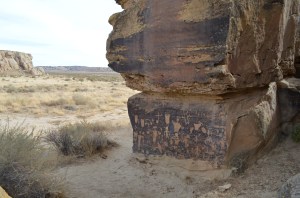
Hopi Reservation petroglyphs:

Amigo Cafe, Kayenta, AZ:

As we made our way over to Monument Valley, we passed through the town of Kayenta, AZ. According to the usual sources on the road (Yelp, TripAdvisor, RoadFood…), Amigo Cafe is the best place around. It was a cozy, warm space serving Navajo, Mexican, and American dishes.

Navajo taco and chicken chimichanga:

The View Restaurant, The View Hotel, Monument Valley, UT:

Monument Valley is spectacular. Truly. A sacred place for the Navajo, it was also a popular setting for old Westerns, and you’ll likely have the sense that you’ve seen this place, even if you’re not a John Ford enthusiast. The loop through the park is extremely rough road, making for a very slow drive, even with 4-wheel drive. We did see RVs and even a Prius making the trip, but it did not look fun.

The restaurant is part of the hotel and it is within the park limits. The restaurant has a breathtaking view of the rock formations that make up Monument Valley. The staff were kind and the menu spans Navajo specialties and American standards. There’s also a sizeable gift store with Native American items representing many area nations and a wide range of price points. Definitely take a closer look if you’re there.

Green chile stew with fry bread, Navajo tacos, and Navajo tea:

Monument Valley:

Chinle Flea Market, Chinle, AZ:

Canyon de Chelly, called Tseyi by the Navajo, is a spectacular canyon that bears evidence of the native people who have lived here for millenia, from petroglyphs and cliff dwellings to working Navajo farms. It is also the home of Spider Rock, a sandstone spire sacred to the Navajo that rises about 750 feet up from the canyon floor. The park has a welcoming visitor center with cultural programs that are definitely worth attending. The options for traveling inside the canyon are limited unless you are with a Navajo tour guide. Note that driving along the canyon rims is open to all and really spectacular, with decent views of some cliff dwellings. We had a Navajo guide named Lee who drove us along the canyon floor, where his family has farmed and lived for many generations (except for the four-year period from 1864 to 1868 when the Navajo were removed from the land after surrendering to Kit Carson, and forced to walk to Bosque Redondo Reservation in Fort Sumner, now New Mexico).

Lee taught us a lot about the canyon and shared his thoughts on contemporary Navajo culture. We got to talking with him about food and our shared love of Korean food, among other things. He told us a bit about Navajo food, and suggested we try a roast mutton sandwich. As luck would have it, we were in Chinle on a Friday and the local flea market took place from 12-2 pm. Lee told us about his favorite vendor. As he described it, go to the specified parking lot, pass some guys selling and repairing tires, go about 100 yards, turn left, go another hundred yards and look for the white trailer selling mutton sandwiches. And, he told us, be sure to use salt because Navajo food can be, well, a little bland.

It was a very windy day, which caused what I can best describe as a sand storm. We had to shield our faces when the wind picked up, but we spotted a white trailer with a roast mutton sandwich on the menu. It was called C&H. The trailer had a couple of long tables set up out front, covered by a tarp that also blocked the wind and sand. We also got an extra fry bread for our daughter and a cup of Navajo tea. The smell of grilled meat coming from the trailer was enticing, and the fry bread was made to order. A grilled hot green chile and the thinly sliced, grilled mutton were placed in the bread and a couple of salt packets were tucked on the tray. It was a straightforward sandwich, with the strong flavors of mutton and green chile, the earthy, chewy meat working in concert with the crispy fry bread. The addition of salt brought the sandwich to life.

When we were finished, we walked a bit farther and realized that there was another white trailer selling mutton sandwiches just beyond C&H! Since Lee hadn’t specified the name of his favorite place (and we hadn’t thought to ask!), we just went to the first one we saw that matched his description. So, we ordered one at the other stand as well. It’s menu board revealed it’s name: That One Stand. We ordered this one to go, so we could eat it in the car. This stand also made the fry bread to order, topped it with mutton and a green chile straight off the small grill in the trailer, again with a couple of salt packets. Similar to the sandwich from C&H, with the strong flavors of mutton, chile, and salt wrapped up in crispy fry bread, this iteration had somewhat thicker pieces of mutton.

We were so glad that Lee told about the food stalls at the flea market. In fact, walking through the flea market, even though there was a sand storm, and getting to try two versions of a favorite Navajo food was one of my very favorite moments from the trip.

Roast Mutton sandwich with a roasted green chile on fry bread, one from C&H (along with an extra fry bread and a Navajo tea) and the other from That One Stand:

Shiprock Flea Market, Shiprock, NM:

Our next major stop was Hovenweep National Monument in Utah, where 13th-century multistory stone towers are perched on the rim of a canyon. On our way to Farmington, NM—our stop before venturing down to Chaco Culture National Historical Park—we passed through Shiprock, NM. We spied a flea market in a parking lot on Route 64, then caught sight of smoke rising from a drum grill, and after opening the window, caught the scent of roasting meat. We swiftly pulled in. An older Navajo couple were selling mutton sandwiches. Rather than fry bread, it used oven bread. It was delicious.

Roast Mutton sandwich with a roasted green chile on oven bread:

IMG_7110

La Cueva Cafe and Orlando’s, Taos, NM:

La Cueva is a tiny and very popular place at the edge of downtown Taos that serves Mexican and New Mexican food.

Cheese enchiladas and chicken tacos, La Cueva Cafe:

For dinner, we tried another wildly popular Taos spot for New Mexican and Mexican specialties. Quite a bit farther out from downtown, it’s an ultra cool place with vibrant Chicano art on the walls. A great pick for a fun night out. Sorry about the poor picture quality—it was a pretty dark place.

Los Colores (three enchiladas with green, red, and el caribe chile) and stuffed sopaipillas, both with beans and hominy:

Taos Pueblo, Taos, NM:

Taos Pueblo has been the continuous home of the Taos Pueblo people for over 1,000 years. A World Heritage Site by UNESCO and a National Historic Landmark, it is a truly beautiful place. Tribal volunteers give tours of the site (recommended), and there are many artisans selling their work along the areas of the pueblo that are open to the public. There are also many people selling Taos oven bread cooked in traditional ovens (both shown below)—and other oven-baked treats like cookies. There are a number of options for hot food. We had a fry bread sandwich.

I was in Taos many years ago and, unfortunately, it happened to be on a day when the Taos Pueblo was closed to the public. This time, I checked in advance to make sure we were there when it was open. I’m so glad I did. I will long remember wooden ladders perched against adobe walls reaching up to the vast blue sky (homes used to be accessed through entrances on the roof)…doors painted vibrant turquoise against the soft brown adobe walls…the pueblo buildings huddled close to each other, rising from the brown earth, with the river in front and the mountain behind…. It’s such a special place.

Outdoor oven, oven bread, and chicken fry bread sandwich from Ai-Thloo’s (Grandma’s) Kitchen:


Rancho de Chimayo Restaurant, Chimayo, NM:

We stopped in Chimayo on our way down to Santa Fe on the famed High Road to Taos (or, in our case, from Taos), winding through the Sangre de Cristo mountains. Chimayo, which isn’t far from Santa Fe, has a 300-plus-year history of weaving, notably by many generations of the Ortega and Trujillo families. Chimayo is home to El Santuario de Chimayo, a Catholic pilgrimage spot believed to have curative powers. I’ve read the church gets about 300,000 visitors per year. And Chimayo is also home to the Rancho de Chimayo Restaurant, winner of a 2016 James Beard Foundation America’s Classics Award. I hadn’t heard of the restaurant—it was recommended by a seventh-generation weaver from the Trujillo family at their shop.

In 1965, Florence Jaramillo and her husband Arturo restored his family’s ranch and opened it as Rancho de Chimayo restaurant, serving New Mexico cuisine. Florence went on to become a New Mexico food legend. She still owns Rancho de Chimayo and can be seen working there even now. The restaurant is known for a few dishes, notably the sopaipillas, spicy guacamole, and carne adovada, and they are known as the first restaurant to serve stuffed sopaipillas. The place itself is beautiful, and the service is warm and attentive.

Prickly pear frozen lemonade, sopaipillas, carne adovada, and rolled flautas:

The Pantry, Santa Fe, NM:

We went to the Pantry a number of years ago and I honestly nearly wept with joy eating the carne adovada, bringing the richly flavored meat to my mouth wrapped in a flaky sopaipilla. With all of the things we went to the Southwest to do on this trip—including seeing Chaco Canyon, Canyon de Chelly, Hovenweep, and so on—I was not going to miss the opportunity to tuck into another plate of this divine adovada! And you know what? It was as good as I remembered. With any luck, I’ll be able to go back again soon.

Carne adovada and Frito pie:

Santa Fe Bite and Luminaria, Santa Fe, NM:

Green chile cheeseburger from Santa Fe Bite and the Thanksgiving turkey special from Luminaria:

The Cuban Sandwich: A Tampa Tradition

Sure, you know what a Cuban sandwich is. Ham, roast pork, Swiss cheese, pickles, and mustard on Cuban bread, usually pressed to crisp the bread, warm it through, and start to melt the cheese. But did you know that the Cuban sandwich was invented in Tampa, FL, and in the city, Genoa salami is also an integral ingredient? In 2012, the “Historic Tampa Cuban Sandwich” was declared the “signature sandwich” of the city by a resolution of the Tampa City Council. There’s a strong rivalry with Miami about which city is really the home of the Cuban sandwich. But history is on Tampa’s side, with the first evidence of the sandwich dating back to before 1900, well before they were on the scene in Miami.

According to local lore, the sandwich developed over time by adopting ingredients from the various immigrant communities that settled in Tampa. Cubans brought the ham and roast pork; Italians, the salami; and Jews and Germans, the Swiss cheese, mustard, and pickles. Of course, there was no concerted effort to create a sandwich to reflect all of these groups. But the story is emblematic of the way foods sometimes develop, taking a little from this group, a little from that, resulting in something new…and the story is certainly emblematic of American food.

Back to that public resolution: it is very specific about how a Historic Tampa Cuban Sandwich is made. It includes an eight-point list that lays out precisely how to make one—but remains oddly silent on the question of whether it should be hot or cold. A peek at the minutes of the City Council meeting reveals that they thought weighing in on this point would be micromanaging–hilarious! The level of specificity in the resolution is so delightful, I’ll share it in its entirety:

Be it resolved by the City Council of the City of Tampa, Florida:

Section 1. That the City Council of the City of Tampa hereby defines, designates and authenticates the “Historic Tampa Cuban Sandwich” as a sandwich which was prepared utilizing only the following ingredients and process:

1) Use Cuban bread which is an all-natural, white wheat flour loaf and is made by scoring the loaf with palmetto palm fronds, and which bread has been stored in a paper bag;

2) Cut loaf of Cuban bread into 8-10” pieces and cut bread lengthwise, with scored portion on top;

3) On bottom piece of bread place a slice of ham;

4) On top of ham, place a slice of Cuban style roast pork made by marinating the pork in garlic and mojo sauce;

5) On top of pork, place a slice of natural dried, cured Genoa salami;

6) On top of salami, place a slice of dry Swiss cheese;

7) On top of cheese, add 3 sliced dill sandwich pickles;

8) On top piece of Cuban bread (scored portion), spread yellow mustard and place on top of sandwich.

Now that’s taking the details very seriously.

After some research, we chose five places to try the sandwiches. We were able to get to just three of them: Columbia Restaurant, West Tampa Sandwich Shop, and Brocato’s Sandwiches. Due to two (!!) rental cars with problems (two separate useless cars!!), we did not get to try La Segunda Central Bakery or Michelle Faedo’s On the Go food truck. Sadly, we were most looking forward to those two. If we make it back to Tampa, we’ll make those two our first stops.

Columbia Exterior

Columbia Restaurant

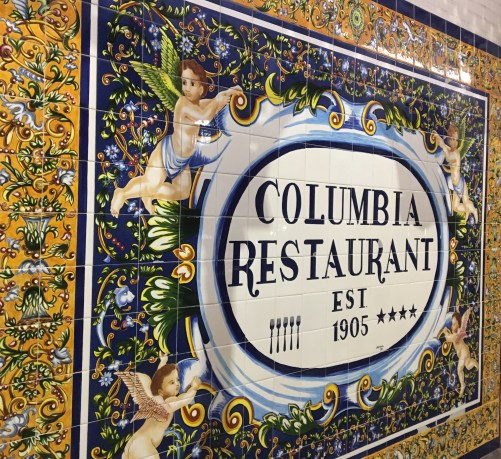
Columbia Restaurant is a sprawling building with multiple dining rooms and a gift shop. It’s been an anchor in the Ybor City neighborhood since 1905, making it Florida’s oldest restaurant (a title for which they have secured a service mark: Florida’s oldest restaurantSM). The original café, founded by Cuban immigrant Casimiro Hernandez, Sr., was known for Cuban coffee and Cuban sandwiches. It’s now owned by the fifth generation of the same family. The family has opened five more locations by the same name, stretching from Tampa to as far away as St. Augustine, as well as a seventh place called Ulele. Several tables around us were celebrating birthdays, and there were a number of large parties, and that was on a Wednesday. It’s that kind of a festive spot, if touristy.

Columbia Restaurant gives a little history of the Cuban sandwich on their menu. Created in the 1890s as the mixto, the sandwiches were developed for the workmen at the local Ybor City cigar factories. The restaurant uses the same recipe that they introduced in 1915. The menu includes that lore about the contributions of the various Tampa ethnic groups to create a sandwich that reflected the community: “The city of Tampa was like the sandwich, a mixture of cultures and food.”

Columbia Cuban

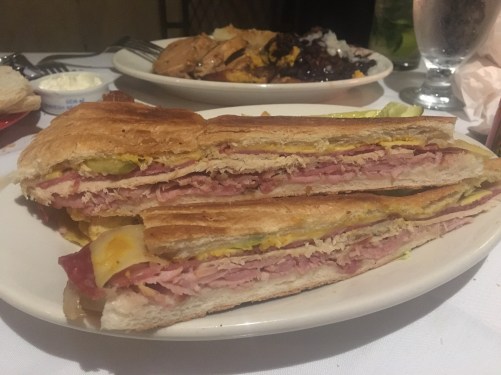
The Cuban bread at Columbia is from La Segunda Central Bakery. It’s as light as air inside with a faint sweetness, perfectly crisp and crumbly outside—just lovely. And that’s what they use for their Cuban sandwich. The bread is brushed with butter and pressed, so the airy quality is diminished, but the result is crispy, flaky, and toasty. The ham contributed a subtle sweetness, the roast pork gave a shot of unctuous, garlicky goodness, and the salami—a necessity in a Tampa Cuban—adds a gentle note of heat and spice. The Swiss had good bite, and the mustard and pickles didn’t overpower, but rather offered a foil to the richness of the trio of pork. The sandwich was in a way reminiscent of a ham and cheese croissant, flaky and buttery. It was well balanced, with all the ingredients standing out, but none hogging the spotlight. It comes with an ample side of plantain chips and a somewhat superfluous pickle. This was the best Cuban sandwich I had in Tampa.

West Tampa Sandwich Shop

West Tampa Sandwich Shop

A humble spot with an exterior that looks bleached by the hot Florida sun, West Tampa Sandwich Shop is another local institution. So much so, President Obama stopped by. He ordered a honey Cuban—honey is pressed into the bread to provide a sweet note—with lettuce and tomato, which is now the Obama sandwich on the menu. We got a classic Cuban and an Obama.

West Tampa Cuban

West Tampa Sandwich Shop is a no-frills place, and their Cuban was a no-frills sandwich. I had a few issues with it, like too much mustard, a skimpy slice of salami, and barely any roast pork at all. And the ham was pretty basic. But it was a good and satisfying sandwich nonetheless, and at $3.60 for the regular size, it’s easy to like. Note that they include mayo as a default, but the waitress did ask specifically whether we wanted each topping offered—mustard, pickles, lettuce, tomato, and mayo. As for the Obama, the honey pressed into the top of the bread provides a foil to the saltiness of the meats and the pickle, and the sharpness of the Swiss and mustard. The lettuce, tomato, and mayo add moisture to a sandwich that can tend to the dry.

Brocatos Exterior

Brocato’s Sandwich Shop

Brocato’s is clearly a Tampa tradition. The place has been around since 1948. While it wasn’t insanely busy when we were there, they are set up for massive lines. The décor belies the place of Brocato’s in the food history of Tampa—awards, mail order options, famous guests, etc.

Brocatos Cuban

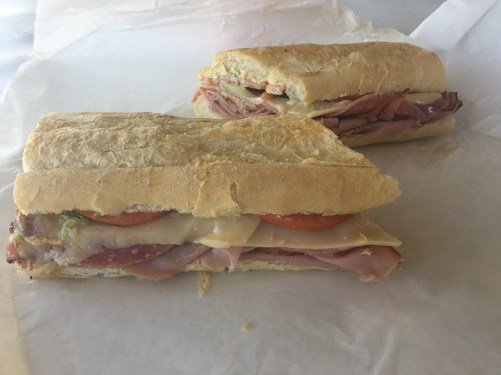
So, I ordered a Cuban sandwich here…in Tampa, as in “Historic Tampa Cuban Sandwich,” as in expecting the steps outlined in that city resolution…and what I got was a cold Italian sub with lettuce, tomato, and mayo, in addition to the requisite ingredients. It was on Italian bread—not pressed, not warm, not toasty. Not at all what I was expecting, or what I was on a mission to eat. The place is not cheap, and it takes a while to get your food. Sandwiches come with a small bag of chips (grab your own in the large garbage cans by the pick up window) and a soda.

Brocatos Devil Crab

To be fair, Brocato’s seems to be known for their devil crabs, another Tampa tradition. They have plenty of signage about how you can get them mail ordered. Devil crabs are essentially crab croquettes. The ones at Brocato’s are huge, and they’re known for that (note that they also serve minis). The filling included ample lump crab, but also a generous dose of green bell peppers and I believe tomato and onion. The crab filling was tasty, if a bit too wet and a bit too loaded up with peppers, but I thought the size ultimately worked against the dish, throwing off the balance between the coating and the moist filling.

Sour Cream Apple Squares

DSC_1501

It’s apple-picking season. If you live in the New York City metro area, chances are pretty good that you were at an orchard in northern Westchester County this weekend. At least it seemed that way, with so many people there, picking apples, eating cider donuts, letting the kids run free for a bit.

IMG_8194

Here’s a recipe for sour cream apple squares. This is a recipe my mother used to make, and they have an old-fashioned quality to them. Not terribly sweet, they are a moist apple-filled cake (of sorts) atop a crumble-meets-shortbread base. They remind me of a grandmother’s dessert, served to friends with coffee. I actually brought it to a couple of dinner parties a few years back when I was tasked with providing a dessert and others agreed—it has a comforting, warming feel.

I hope you enjoy the recipe! Note that although the image below shows that I used a Pyrex baking dish, I suggest avoiding a clear pan so you don’t risk making the crumbly bottom too crisp.

IMG_8172

IMG_8184


° ° ° ° ° ° ° ° ° ° ° ° ° ° ° ° ° ° ° ° ° ° ° ° ° ° ° °

Sour Cream Apple Squares

Ingredients:

2 cups all-purpose flour

2 cups firmly packed brown sugar

½ cup butter, softened

1 cup chopped walnuts

1 tsp cinnamon (I actually use 1/2 tsp, but I’m not crazy about cinnamon)

1 tsp baking soda

½ tsp salt

1 cup sour cream

1 tsp vanilla

1 beaten egg

2 cups apples, peeled and finely chopped (about 2 apples)

° ° ° ° ° ° ° ° ° ° ° ° ° ° ° ° ° ° ° ° ° ° ° ° ° ° ° °

Preheat oven to 350°.

Combine flour, brown sugar, cinnamon, and butter. Mix together until crumbly. Stir in nuts and press 2¾ cups of the crumb mixture into an ungreased 9 x 13 inch pan. To the remaining crumb mixture, add baking soda, salt, sour cream, vanilla, and egg. Blend well. Stir in the apples. Spoon the mixture evenly over crumb base.

Bake for 30 to 35 minutes, until a toothpick (or whatever you have on hand) comes out clean. Try not to overcook. Let cool and cut into squares.


Zuppardi’s Apizza: A West Haven, CT Landmark

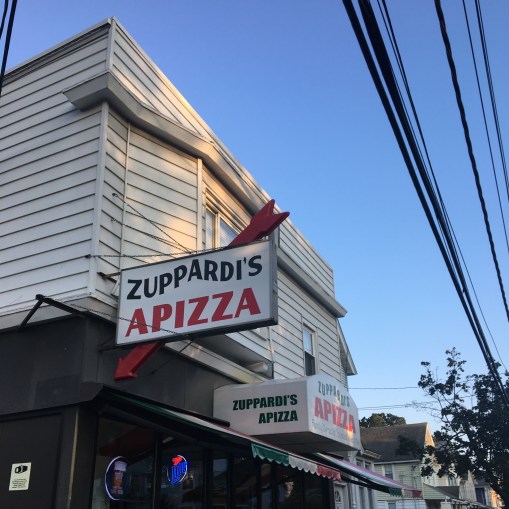
exterior

Just a short ride from New Haven pizza legends Pepe’s, Sally’s, and Modern, West Haven, CT has its own iconic spot: Zuppardi’s Apizza. For about eight decades, they’ve been serving up New Haven-style pizzas in an unassuming space in a residential neighborhood by the beach.

Master bread-baker Dominic Zuppardi originally opened a place called Salerno’s Bakery in New Haven in 1932, moving it to Union Avenue in West Haven in ’34. By the 1940s, Dominic’s son Anthony took over and started making pizzas. He changed the name to Zuppardi’s Apizza in ’47, and the rest is West Haven history. Anthony’s kids and grandkids run the place today, still at the same Union Avenue location.

The first Zuppardi pizzas were plain pies, just tomato sauce and pecorino—like the Original Tomato Pie over at Frank Pepe’s on Wooster St. with its crushed tomatoes, olive oil, oregano, and grated cheese. Zuppardi soon started to add his homemade Italian fennel sausage to the pizzas. It was a real success then, and remains so today.

slice with meat and veggies

Unlike some of its New Haven counterparts, Zuppardi’s doesn’t use a coal-fired oven, but rather a gas one. The dough is a little thicker than at the other places, and chewier, too, but it still delivers a crisped crust and the characteristic slight char of New Haven pizza. In fact, the dough has a lot of the characteristics of a great artisan Italian bread. And the toppings are all high quality.

two pies

Today’s menu remains true to its history. The Traditional Plain Pie is just that—tomato sauce and pecorino, with garlic upon request. (Note that in New Haven, and in West Haven, you specifically ask for mozzarella when you want it.) The Special Pizza is another Anthony original: red sauce, mozzarella, mushroom, and that homemade fennel sausage.

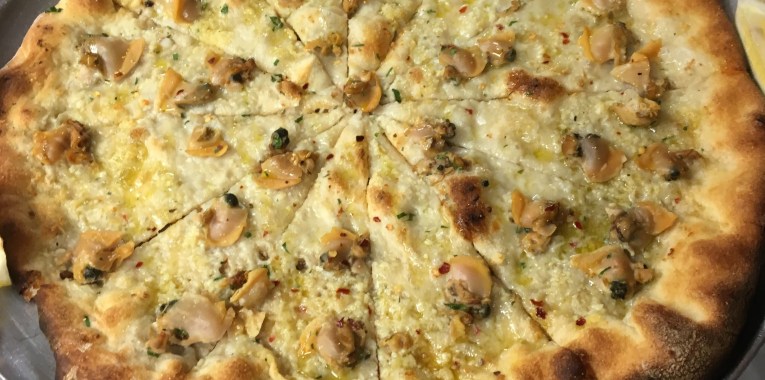
Zuppardi's clam apizza

They also do a clam pie, a New Haven classic. As you can see above, it’s a thing of beauty. They use shucked-to-order littleneck clams along with garlic and spices, flecked with crushed red pepper, and served with lemon wedges. Many regard Zuppardi’s clam pizza as the best one in the area—myself included. Although it can be pricey (depends on the market price for the fresh clams), it’s delicious, and it’s best eaten right away. This is not the right choice if you’re looking for leftovers: the clams get hard and rubbery and the crust gets soggy. But straight out of the oven, it’s briny, garlicky bliss.

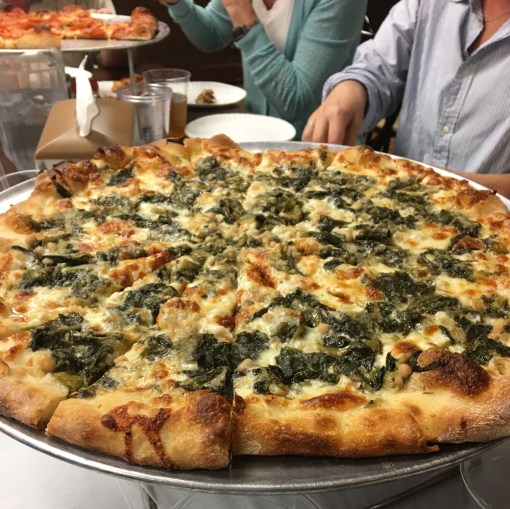
white bean and escarole

Another stand-out specialty is the beans and escarole pizza: a white pizza with cannellini beans, sautéed escarole, mozzarella, fresh garlic, and olive oil. Consider throwing in some of the fennel sausage, too. Zuppardi’s has all the usual toppings, too, of course, and a few questionable specialties, like Buffalo style chicken. They also have some other menu items, like salads and appetizers, which isn’t the case with all the big name places in New Haven. They serve beer and wine as well as the great Foxon Park sodas, another local treat. If you’ve never had their white birch, try it.

slices

If you’re exploring New Haven pizza, which you absolutely should do, take the short trip out to West Haven and sample the Zuppardi’s take on this regional specialty.

Zuppardi’s Apizza

179 Union Avenue, West Haven, CT

www.zuppardisapizza.com

Pork Tenderloin Wrapped in Bacon


My husband and I are new to pork tenderloin. I recently saw an episode of Ina Garten’s new show where she made one and I was intrigued. (http://www.foodnetwork.com/recipes/ina-garten/cider-roasted-pork-tenderloins-3742577). Not long after, I noticed the cut on sale and figured, why not? I tried Ina’s recipe. We liked it, but mostly we couldn’t believe how great pork tenderloin is. What a couple of fools to have not realized that before. I tried Ina’s recipe a second time with a few tweaks and (sorry, Ina) liked it better. The recipe has too much stuff going on: hard apple cider, maple syrup, rosemary, fennel seed, ginger, cinnamon, coriander, pepper…. For take two, I dropped the ginger and cinnamon, and went with a pear cider (we were out of apple). Here’s a shot of it sliced, and a shot of lunch the next day, with a more thinly sliced tenderloin, salad, and quinoa…

Pork Tenderloin SlicedPork Tenderloin

It had less dynamism, and I mean that in a good way. The original kind of jumped around the palate with so many things going on. But I digress. This is about the “weeknight porchetta” recipe from Bon Appétit (Jan. 2015) on epicurious.com.

Weeknight Porchetta

http://www.epicurious.com/recipes/food/views/weeknight-porchetta-51260410

Weeknight Porchetta 1
Ready for the Oven
Weeknight Porchetta 2
(A Little Over)Done
Weeknight Porchetta Leftovers
Leftovers

Notes: I used a frying pan to roast the tenderloins because I intended to put it on the stovetop at the end of cooking to crisp the bacon. But there was way too much liquid in the pan for that. I opted for the broiler, but the result was uneven. Also, the tenderloin got overcooked. I checked the internal temp at 25 minutes (cooking time is given as 40-45). I let it go another 8, which was too much, and then broiled a bit (for aforementioned crisping). Tenderloin is pretty forgiving, so it still tasted good, but I certainly should have taken it out a lot earlier. Though not in the recipe, I added as many tiny little potatoes to the pan as I could fit in. Great choice. They were amazing—tiny potatoes roasted in bacon fat and lightly flavored with rosemary, garlic, and fennel seed. The next day, I had some cold slices with a simple arugula salad. It was a little dry, but not terrible, and the cold bacon wrap was less unappealing than I had feared it would be. The leftovers from Ina’s recipe were fantastic—again, just had it sliced cold alongside a salad.

Would I try this recipe again? Maybe, in a bigger pan with a lot more potatoes, and if I could get the bacon to crisp up evenly and not overcook the thing.


Hard Shell Tacos

I love tacos. I really do. (Sure, everyone loves them now, but that’s a fairly recent thing.) When I first moved to California, I was not an instant fan, but over time, I was converted. By the end of my time in LA, I spent the better part of several Saturday days trying tacos all over the city, from taco trucks in the parking lots of South Gate car washes and downtown Thai grocery stores, to Highland Park markets and Mar Vista taquerias. Carnitas, Baja-style fish tacos, potato, chorizo… I love them in many incarnations. When my husband and I eloped in Santa Barbara, our first meal as a married couple was at a simple taqueria just a stone’s throw from the 101 with eyeball and tongue tacos on the menu (we had carne asada). After moving away from LA to a place not well known for Mexican food, I learned how to make my own corn tortillas; I make carnitas; I’ve got epazote, masa harina, and several types of dried chiles in my pantry.

Have I established my taco-love? While I’d never claim to make a truly authentic taco, I know I’ve eaten them…at least ones authentically filtered through a southern California lens. So, to reiterate, I love tacos.

IMG_7425

And I love hard shell tacos. I’ve loved them since I ate them as a suburban CT kid, filling them with ground beef cooked with a convenient spice pack, accompanied by shredded iceberg lettuce, chopped tomatoes, shredded cheese, and so on. It may not be cool in food circles to admit loving hard-shell tacos, but so what? The truth is the truth. And last week, New York Times food editor Sam Sifton confirmed that he loved them, too. He wrote this comprehensive story about them in the Times: https://www.nytimes.com/2017/05/11/magazine/the-case-for-hard-shell-tacos.html. The recipe for “Middle School Tacos,” as he calls them, is here: https://cooking.nytimes.com/recipes/1018758-middle-school-tacos.

I still love hard shell tacos filled with the expected spiced ground beef, but also shredded chicken, or black beans even. And I always include a spread of toppings—some combination of tomatoes, onions (raw or pickled or, even better, both), sour cream, salsa, avocado (or guacamole), toasted pumpkin seeds, cheese (monterey jack, cotija, or feta)…you get the gist.

I have made hard shell tacos for dinner guests several times. In each case, my guests hadn’t had these tacos in ages. They enjoyed the nostalgia, and also the fun. I mean, come on—the crunch, the toppings, the mess…what’s not to love? Are they authentic Mexican? No, of course not. The matter has been written about by many others, Sam Sifton included. Does it matter that they’re not authentic Mexican tacos? Not in my opinion, not in this case.

Schwartz’s, Montreal

A Montreal icon, Schwartz’s has been serving up exceptional smoked meat (think pastrami, but with some subtle differences) in the same spot in the Mile End neighborhood since 1928. While the menu includes other deli classics, such as turkey, salami, and liver, people line up for the smoked meat, which is marinated for ten days and smoked fresh every day. Get a smoked meat on rye and a ½ sour and you’ll see why they have a passionate following after so many decades—sliced thin and piled high, the meat is tender and packed with flavor. You can get the meat normal or lean, with or without mustard. The fries are also tasty.

3895 Saint-Laurent Boulevard, Mile End

Open seven days

8:00 am to at least 12:30 am; hot meat (including the smoked meat) available after 10:30 am